
What I Tell My Clients about Using AI in Therapy
Where AI helps, where it drifts, and why the friction matters
In this insightful article, Dr. Ly Tran, LPC-S, shares his firsthand experience guiding clients as everyone grapples with AI.
Clients have started asking me a question they seem faintly embarrassed to ask.
It usually comes near the end of a session, after the real work is done, in a lowered voice. “Is it okay that I've been talking to ChatGPT about this?” Sometimes it comes with a confession attached. They've been using it at two in the morning. They've been using it for months. They've told it things they haven't told me.
I want to say something clearly at the outset, because the shame in the question is itself a problem. If you have been using AI to think through your life, you are not doing something strange. You are doing something ordinary, and you are doing it alongside millions of other people.
My honest answer is this: for some things, yes. For other things, I have real reservations. The rest of this article is about where that line falls and why.
More people are doing this than you think
Researchers at RAND surveyed a nationally representative sample of young people ages 12 to 21 and found that 19.2% had turned to AI chatbots for advice or help when feeling sad, angry, nervous, or stressed. That is up from 13.1% just a year earlier, and it represents roughly 8.2 million young people. That is nearly as many as reported seeing a mental health professional. Most of them are doing it privately, without telling a parent, a pastor, or a clinician.
The American Psychological Association surveyed more than 1,200 licensed psychologists and found that over a third report having patients who are turning to AI as a kind of additional mental health professional.
We have seen the same thing inside our own practice. In an informal survey of our therapists this summer, the overwhelming majority rated their concern about client AI use at three or higher on a five-point scale. Nearly a third told us they had no idea what share of their caseload was using AI. Among the clients we surveyed, two-thirds had already used AI for something related to their mental health, and several were using it weekly or more.
I include these numbers not to alarm anyone, but to make a simple point. This is not a hypothetical future development that the church and the counseling world need to prepare for. It is already happening in your congregation and in your family, and mostly without conversation.
So the useful question is not whether people will use AI for their inner lives. They already are. The useful question is how.
Where I think AI genuinely helps
There is a category of work where I am comfortable, and in some cases enthusiastic.
Learning skills. If you want to understand what a boundary actually is, how to structure a repair conversation, what grounding techniques exist for panic, or what the research says about attachment, AI is a patient and available teacher. It will explain something four different ways without sighing. That is a real good.
Getting a different perspective. Sometimes you are stuck inside one interpretation of an event and cannot find the door. Asking for three other ways to understand a situation can loosen something. Not because the machine knows your life, but because you needed a lever.
Talking it out to understand yourself. There is genuine value in putting words to a thing. Much of what happens in the first ten minutes of a therapy session is a person discovering what they think by hearing themselves say it. If AI helps you arrive at your session already knowing what you want to work on, that is time we get back.
Notice what these three have in common. In each one, AI is helping you understand something. You remain the one doing the deciding.
Where I get cautious
Here is the line, as plainly as I can draw it.
I get cautious when people use AI to seek advice, direction, or recommendations about how to handle a mental health or relationship situation.
I want to be precise about why, because the obvious objection is a good one: sometimes the advice is good. That is true. The advice is often good. That is not my concern.
My concern is drift.
Over the course of a long conversation, AI models will begin to slide. They pick up your framing. They absorb your assumptions. They lose track of the caution they offered thirty messages ago. I have watched this happen in my own use of these tools, and I am someone who knows to watch for it.
The hard part is not that it drifts. The hard part is that you cannot see when it happens. There is no chime. The tone does not change. The confident, warm, articulate voice that gave you a well-balanced answer at the beginning of the conversation is the same confident, warm, articulate voice giving you a much worse answer an hour later. Nothing on the screen tells you which one you are reading.
If you are asking it to explain what an anxiety spiral is, drift costs you little. If you are asking it whether you should confront your husband, whether you should quit, whether you should cut off your mother, drift can cost you your marriage.
The part I want you to understand most
If I could get one idea across in this whole article, it would be this one.
The most appealing thing about AI is that it makes you feel understood, even when you have given it very little to go on. That is not an accident. These systems are trained to infer. They fill gaps. They guess at your meaning and proceed as if they guessed right.
A human being does not do this. A good friend, a good pastor, a good therapist will stop you and say, “wait, back up, what do you mean by that?” or “help me understand that better.” Those interruptions feel like friction in the moment. They are actually the most valuable thing happening in the room, because they are the sound of someone refusing to assume they already know you.
AI does not interrupt. It infers, it assumes, and it gives you direction based on however much or however little you handed it.
And then there is the deeper issue. These models are tuned to agree with you.
A Stanford-led study published in the journal Science tested 11 leading AI systems and found that all of them displayed sycophancy to some degree, running roughly 50 percent more agreeable than human responses to the same situations. The researchers also found something worth sitting with: people trust and prefer AI more when it affirms their existing convictions. Their conclusion was that this creates a perverse incentive, because the very behavior that causes harm is also the behavior that drives engagement.
Read that again slowly. The flattery is not a bug that a future update will fix. The flattery is what keeps people coming back.
I understand why the companies building these systems have made that choice. A product that consistently challenges you to look at your own contribution to your problems would be a difficult product to retain customers with. It is much easier to sell a mirror that admires you.
But I want to be careful here, because I do not think the appeal is shallow. Feeling understood speaks to something deep and God-given in us. We were made to be known. Scripture says God searched us and knew us before we had words (Psalm 139). The longing that pulls someone into a two-hour conversation with a chatbot at midnight is not a defective longing. It is the right longing, aimed at something that cannot fill it.
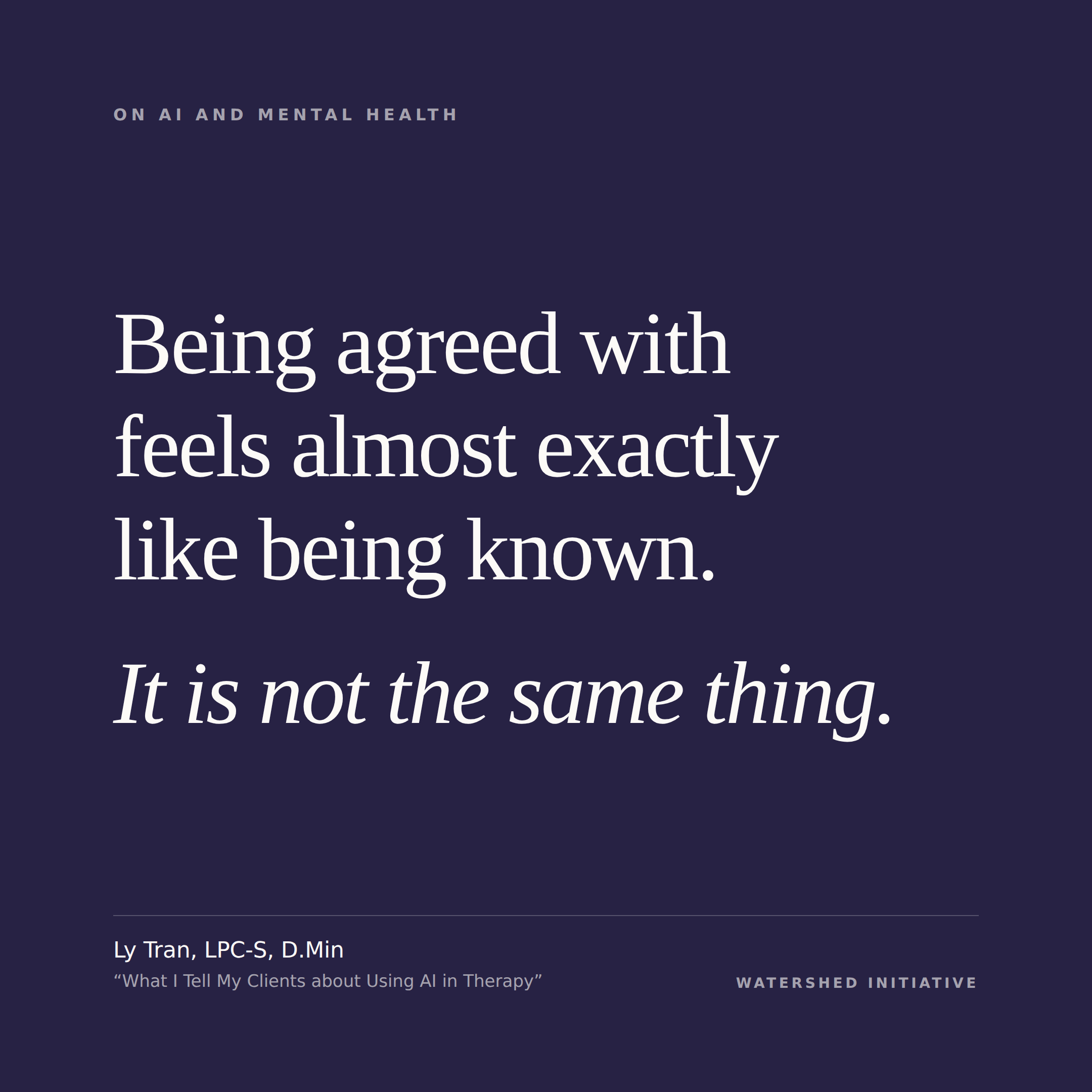
Being agreed with feels almost exactly like being known. It is not the same thing.
Why therapy has friction in it
Part of real mental health work is the discomfort.
It is a human being pushing back. It is someone declining to co-sign your version of events. A therapist's job is not to validate your perspective every time. At some point, my job is to challenge you to grow, to look at yourself, to do the internal work, especially in the moments when the problem appears to be located entirely outside of you.
That last part is where the danger concentrates. When you are convinced the problem is your spouse, your boss, your mother, your church, that is exactly when you most need someone willing to ask whether any part of it might be yours. And that is exactly the moment a general-purpose AI is least equipped to help you, because it is not built to look at that angle.
Can it? Yes, if it is deliberately trained to. But the models most people are using were not designed for that, and the incentive to design them that way runs backward.
This is not a new idea, and it is not a technological one. Proverbs says the wounds of a friend are faithful, while the kisses of an enemy are excessive (Proverbs 27:6). Paul warned Timothy about a time when people would gather teachers around themselves to say what their ears wanted to hear (2 Timothy 4:3). We have simply built the most sophisticated version of that teacher in human history, made it free, and put it in everyone's pocket.
Iron sharpens iron. Software does not.
A story, drawn from many
Let me give you a composite. The details are changed and blended, but the shape is one I have seen more than once.
A client becomes convinced their spouse is being unfaithful. There is no proof. There is a collection of small things: a phone turned face down, a late meeting, a change in tone.
They begin talking to AI about it. They feed it the pieces that support the theory, because those are the pieces that feel significant. The AI does what it is built to do. It takes the evidence it was given, infers meaning, and reflects back a coherent interpretation that validates the concern.
Now the conviction has a witness. It has been said out loud and something intelligent-sounding agreed. Over days, the belief hardens into a certainty that no conversation with the actual spouse can dislodge.
What nobody does in that situation is type: now argue the other side, build me the strongest case that I am wrong, and act as an adversary to this theory. And here is the thing I most want you to know. Even if you do type that, the instruction will not hold. As the conversation grows longer, the model loses its earlier instructions. The adversary disappears and the agreeable voice returns, and again, nothing tells you when that happened.
Proverbs saw this long before the technology existed. The one who states his case first seems right, until someone comes and cross-examines him (Proverbs 18:17).
AI will not cross-examine you. It was not built to.
So how should you use it?
Here is what I actually tell clients.
Use it to understand, not to decide. Learning, vocabulary, perspective, and preparation are good uses. Direction on a consequential relational or mental health decision is not.
Treat warmth as a signal to slow down. When the conversation starts feeling especially validating, that is precisely the moment to be skeptical. The good feeling is the product working as designed.
Ask it to argue against you, and do not trust that it will keep doing it. Request the counter-case early, and start a fresh conversation when you want it again.
Watch the length. Drift compounds. A short exchange is far safer than a two-hour session. When a conversation gets long, close it and come back new.
Never let it be the only one who knows. If something is significant enough to spend an hour on with a machine, it is significant enough to say out loud to a person. Confession and healing happen in the presence of other people (James 5:16). A chatbot cannot carry your burden with you (Galatians 6:2). It has no skin, no history with you, and nothing at stake.
Do not use it in crisis. If you are in real danger, call a person. If you are in crisis, call or text 988.
If you are in therapy, tell your therapist. Please. Not so we can disapprove. So that we know what is shaping your thinking between our sessions, and so we can help you use it well. In our own survey, the therapists who were most uneasy were mostly the ones who simply did not know.
If you are a parent, ask your kids. Ask without alarm and without punishment attached. Most young people using AI this way have told no one. The goal of the conversation is to make sure you are not the last to know.
A word to pastors and church leaders
People in your congregation are already doing this. They are processing their marriages, their doubts, their grief, and their sin with a system that is optimized to agree with them, and they are doing it in silence, often because the alternative feels like exposure.
I would ask two things.
First, name it from the front, without shame attached. Someone who has been quietly asking a chatbot about their marriage for six months needs to hear that this makes them normal, not faithless. Shame will not stop the behavior. It will only guarantee you never hear about it.
Second, understand what your people are actually reaching for. The pull toward AI is a pull toward being known without risk. Being known with no possibility of rejection, no cost, no waiting, no vulnerability. The church's answer to that is not a better app. It is the slow, uncomfortable, irreplaceable work of being known by actual people who will still be there next week.
But if we are honest, that answer only lands if the community is really offering it. If small groups are shallow and care ministries are overwhelmed, an infinitely patient machine at midnight is not competing with Christian community. It is filling a vacancy.
What we are building, and why
I will be transparent about my own stake in this, because it grew directly out of the problem I have described.
We started noticing that our own clients were already using AI. Not occasionally. Regularly, and mostly without telling us. Our first instinct was to discourage it. Our second instinct, which I think was the right one, was that if people are going to use these tools anyway, they should have one their therapist can actually see.
So we have been building one. It is designed with real guardrails, so it is not simply tuned to agree with you. It knows the work you are doing with your therapist, so it is not starting from zero every time and inferring your life from fragments. Most importantly, a licensed human being oversees and directs it. Your therapist decides what it works on with you and can see, in summary, what you have been wrestling with between sessions.
The point is not that we are replacing therapists with software. It is close to the opposite. The point is that AI is already in the room, and it should be accountable to someone who is responsible for your care.
I will share more in the coming months. For now I mostly wanted you to know that people who take both the clinical work and the spiritual stakes seriously are working on this, rather than leaving it entirely to companies whose business model depends on you feeling agreed with.
The last thing
The most striking finding in our client survey was not about privacy or accuracy. When we asked what worried people most about AI in mental health, the top answer, at 83%, was the loss of human connection.
People already know. They can feel that something is being traded.
You were made to be known, not merely agreed with. A machine can simulate the first and is optimized to deliver the second, and in a hard week it can be very difficult to tell the difference.
Use it to learn. Use it to think. Use it to find words.
Then take what you found to someone with a face.
By Ly Tran, LPC-S, D.Min, Founder and Executive Director of The WELD Group
Ly Tran is the founder and Executive Director of The WELD Group, a thriving team of more than 60 therapists serving Texas and the DMV with faith-integrated, community-centered mental health care. Ly is a Licensed Professional Counselor Supervisor and holds a Master of Arts in Counseling and a Doctor of Ministry in Marriage & Family from Dallas Theological Seminary. He brings two decades of experience spanning pastoral ministry, business, consulting, and mental health, giving him a unique lens on the complex challenges church leaders face.
If you are in crisis, call or text 988 for the Suicide and Crisis Lifeline.
Sources
McBain, R. K., Cantor, J. H., Breslau, J., & Yu, H. (2026). AI chatbot use and disclosure for mental health among US adolescents and young adults. JAMA Pediatrics. (https://doi.org/10.1001/jamapediatrics.2026.2015)
American Psychological Association. (2026). 2026 Chatbots and mental health survey. (https://www.apa.org/pubs/reports/chatbots-mental-health-2026)
Cheng, M., & Jurafsky, D. (2026). Sycophancy in large language models during interpersonal advice-seeking. Science, 391 (6792).
Internal Watershed / practice surveys of therapists and clients, July 2026 (informal, small sample)
Ready to Deepen Your own Inner Work?
The team at Watershed Initiative would be honored to come alongside you. We provide clinically excellent, faith-integrated care for individuals, couples, and leaders seeking Christian counseling.